



The video pipeline is the problem
Ask a creator who quit why they quit and the answer is rarely "I ran out of ideas". It is "I could not keep up".
A single video involves a script, a set, lighting, a camera, hair, three takes, an edit, a thumbnail, captions and a posting schedule that punishes you for missing a day. Then the algorithm decides. A 10-minute video can eat a full working day, and you need two of them a week to stay visible.
The pipeline is the burnout. Not the creativity, not the audience. The sheer number of steps between an idea and a published thing.
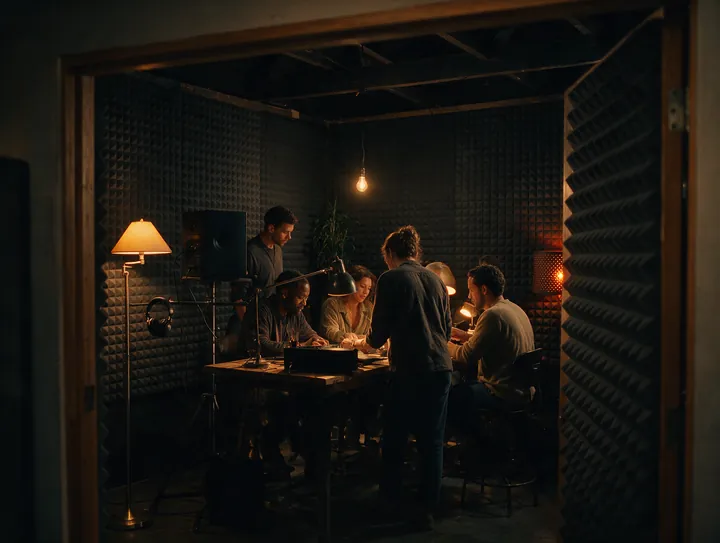
Audio removes most of those steps. You do not have to look like anything. You do not need a location. You can record at 11pm in a hoodie with the lights off. An audio-first workflow is not a downgrade. For most creators it is the only sustainable version of the job.
Batch your recordings
The single biggest change: stop recording on the day you publish.
Pick one recording session a week, 60 to 90 minutes, and record everything for the next 7 days in one sitting. Your voice is warmed up, your mind is in the right mode, and you avoid the daily cost of setting up again.
A workable batch looks like this:
- One long recording (a podcast episode or a long-form talk), 30 to 45 minutes.
- Four to six short takes for voice feeds, 30 seconds each.
- One minute of outtakes and thank-yous you can use later.
Write the prompts beforehand, not the scripts. A list of 8 one-line ideas on your phone is enough. Talking from a prompt sounds like you. Reading a script sounds like reading.
30-second feeds as low-pressure publishing
The reason daily video is exhausting is that every post has to be good. A Speak on Witspeak is 30 seconds of your voice with a title and a topic. That is a different kind of commitment.
A 30-second voice feed is:
- Quick to make. One take, no edit, done.
- Forgiving. A slightly rambling 30 seconds is still a complete thought.
- Repeatable. You can post one on a bad day without it feeling like a performance.
- Discoverable. Listeners find it by topic (Advice, Daily, Motivation, Storytelling and so on) and Play All puts you in a stream with everyone else they follow.
Treat Speaks as your heartbeat. They keep you present with an audience between the bigger pieces, at a cost you can pay every day for years.
Let AI do the parts you resent
Most of the post-production that burns people out is mechanical. Removing hum. Evening out levels. Writing the description. Finding the good bit. None of it needs you.
Witspeak's AI studio was built to take exactly those jobs:
- AI Voice Studio does noise removal, auto-levelling and mastering to -16 LUFS in one tap. No plugin chain, no waveform surgery.
- AI Show Notes and Chapters writes the episode description and timestamps from the transcript.
- AI Highlight Clips finds the best 30-second moments in a long episode and cuts them into the voice feed, which means your short-form content is a side effect of your long-form content, not a separate job.
- Speech-to-Text search makes every episode searchable, so you never need to remember which episode you said the thing in.
What you keep is the part only you can do: the talking. Everything else runs while you make tea.
Set a cadence you can keep on your worst week
Do not plan your schedule around your best week. Plan it around the week you are ill, travelling, or looking after someone.
A realistic audio cadence for one person:
- One episode a week, recorded in the weekly batch.
- Three to five Speaks a week, mostly from the batch, one or two live.
- Two highlight clips from each episode, scheduled, not posted by hand.
If even that is too much, halve it. A fortnightly episode kept up for 2 years beats a weekly one abandoned in month 4. Audiences forgive slow. They do not forgive gone.
Write the cadence down and tell your listeners. "New episode every Thursday" is a promise to them and a boundary for you.
Taking breaks without losing momentum
Breaks are not the enemy of momentum. Unplanned breaks are. The difference is whether your audience knew.
Record ahead. Two spare episodes in the studio, finished and scheduled, turn a 2-week break into a non-event.
Tell people. A 30-second Speak that says "I am off until the 20th, here is what is coming back" keeps the relationship warm. Listeners do not leave because you rested. They leave because you vanished.
Leave something playing. Use goLive to play pre-recorded audio on your channel, or point people at your back catalogue with a short Speak. Your archive works while you do not.
Come back small. Your first post after a break should be a Speak, not a 2-hour comeback special. Ease back in and let the cadence carry you.
The point
The goal is not to publish more. It is to still be publishing in 5 years, with a voice you recognise and an audience that trusts you to show up.
Audio makes that possible because the gap between thinking something and sharing it is 30 seconds, not 8 hours. Take the hours back.
Set up your free podcast and AI studio at https://podcast.witspeak.com/studio/signup, record this week's batch, and give the camera a rest.